



Central Instrumentation Facility (CIF)

| SN | Name | Designation | Contact |
| 1. | Mr. Ramesh Bhardwaj | Senior Technical Assistant | |
| 2. | Mrs. Rashmi Sinha | Technical Assistant | +91-7065474421 |
cifsesjnu[at]gmail[dot]com
011 2670 4562
011 2670 4161
Instruments
Instruments
|
1.AAS
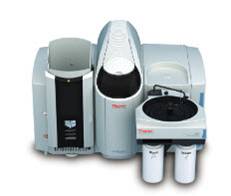
In flame atomic absorption spectrometry, a sample is aspirated into a flame and atomized. A light beam is directed through the flame, into a monochromator, and onto a detector that measures the amount of light absorbed by the atomized element in the flame. Because each metal has its own characteristic absorption wavelength, a source lamp composed of that element is used; this makes the method relatively free from spectral or radiation interferences. The amount of energy at the characteristic wavelength absorbed in the flame is proportional to the concentration of the element in the sample over a limited concentration range.
Application: Quantification of elements in water, wastewater and soil sample, etc. Model: Termo AAS M6 System Sr. No. 651187 Software: AAS SOLAAR |
 |
|
2. XRF
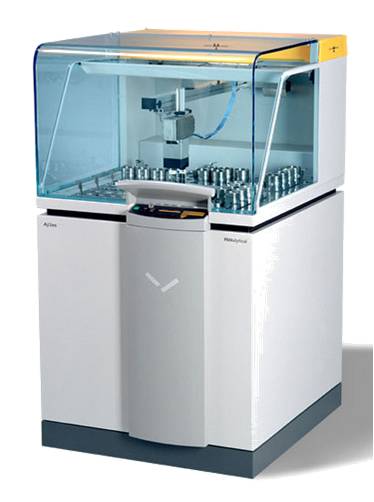
X-ray fluorescence (XRF) is nondestructive technique used in quantitative elemental analysis of a wide range of organic and inorganic samples. The basis for the technique is that all elements emit secondary (‘fluorescent’) X-rays of characteristic energy when exposed to X-rays of appropriate higher energy, with energy and intensity of emitted X-rays used to determine elemental composition. In general, the heavier the element being analyzed, the higher the energy of X-rays required to elicit fluorescence, the higher the energy of fluorescence, and the easier it is to detect fluorescence. The lightest elements found in biological samples (e.g. H, B, C, N, O) are not generally detectable by XRF, while elements such as Na, Mg, P, S, Cl, K, Ca are detectable, but only at high concentrations or with highly specialized conditions, and heavier elements such as the trace metals Mn, Fe, Cu and Zn or toxic heavy metals are readily analyzed, even at trace levels. Major advantages of XRF over ‘wet chemistry’ methods are that analyses are, use no noxious chemicals and produce no toxic wastes, and can be made on solid samples. Since XRF signal is obtained from transitions among inner shell electrons, not bonding electrons, XRF also has the advantage that signal is independent of chemical form. The Wavelength-Dispersive XRF (WD-XRF), which discriminates emissions after diffraction through a crystal. The major advantage of EDXRF over WD-XRF is that equipment is simpler and cheaper with lower output X-ray tubes, albeit with lower resolving power and higher background.
Model: PANalytical WD-XRF AXIO-1 System Sr. No. DY2174 Software: Super-Q |
 |
|
3. XRD
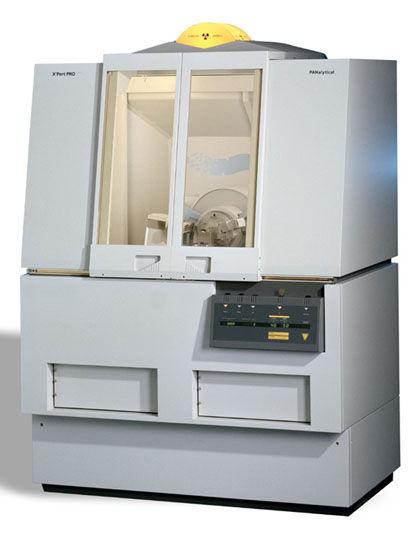
X-ray diffraction is tool used for identifying the atomic and molecular structure of a crystal in crystallographic study, in this the crystalline atoms cause a beam of incident X-rays to diffract into many specific directions. By measuring the angles and intensities of these diffracted beams, a crystallographer can produce a three-dimensional picture of the density of electrons within the crystal. From this electron density, the mean positions of the atoms in the crystal can be determined, as well as their chemical bonds, their disorder and various other information.
Model: Philips Xpert pro XRD System Sr. No. DY1650 Software: Super-Q |
 |
|
4. Spectrofluorophotometer :
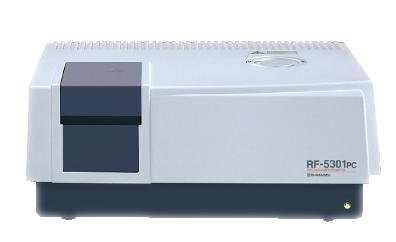
The spectrofluorophotometer irradiates a sample with excitation light of particular wavelength from the light using Xenon lamp and measures the fluorescence emitted from the irradiated sample to perform a qualitative or quantitative analysis.
Model: RFPC Shimadzu Software: RF5301PC |
 |
|
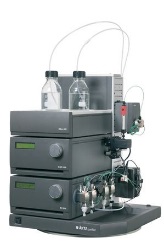
5. Akta Fast protein liquid chromatography (FPLC)
It is a form of liquid chromatography that is often used to analyze or purify mixtures of proteins. As in other forms of chromatography, separation is possible because the different components of a mixture have different affinities for two materials, a moving fluid (the "mobile phase") and a porous solid (the stationary phase). In FPLC the mobile phase is an aqueous solution, or "buffer". The buffer flow rate is controlled by a positive-displacement pump and is normally kept constant, while the composition of the buffer can be varied by drawing fluids in different proportions from two or more external reservoirs. The stationary phase is a resin composed of beads, usually of cross-linked agarose, packed into a cylindrical glass or plastic column. FPLC resins are available in a wide range of bead sizes and surface ligands depending on the application.
Model: Akta FPLC |
 |
|
6. Ultracentrifuge:
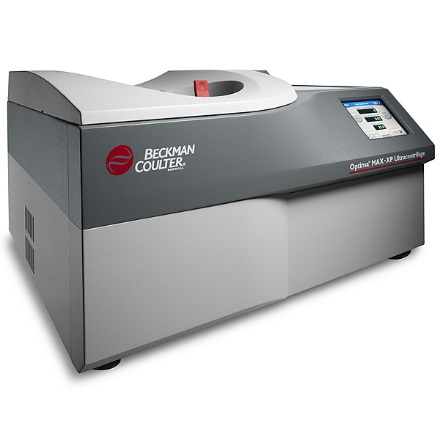
The latest in tabletop ultracentrifuge technology. The OptimaTM MAX-XP tabletop ultracentrifuge is a power-packed solution that delivers fast, efficient separations from samples as small as 200 μl up to 32.0 ml and at speeds of up to 150,000 RPM and more than 1,000,000 x g. Every detail of the Optima MAX-XP is designed with the user in mind–from the system's compact design, versatility and quiet operation to advanced multi-lingual software.
Model: Optima MAX-XP, Bekman |
 |
|
7. Thermal/Optical Carbon Analyzer
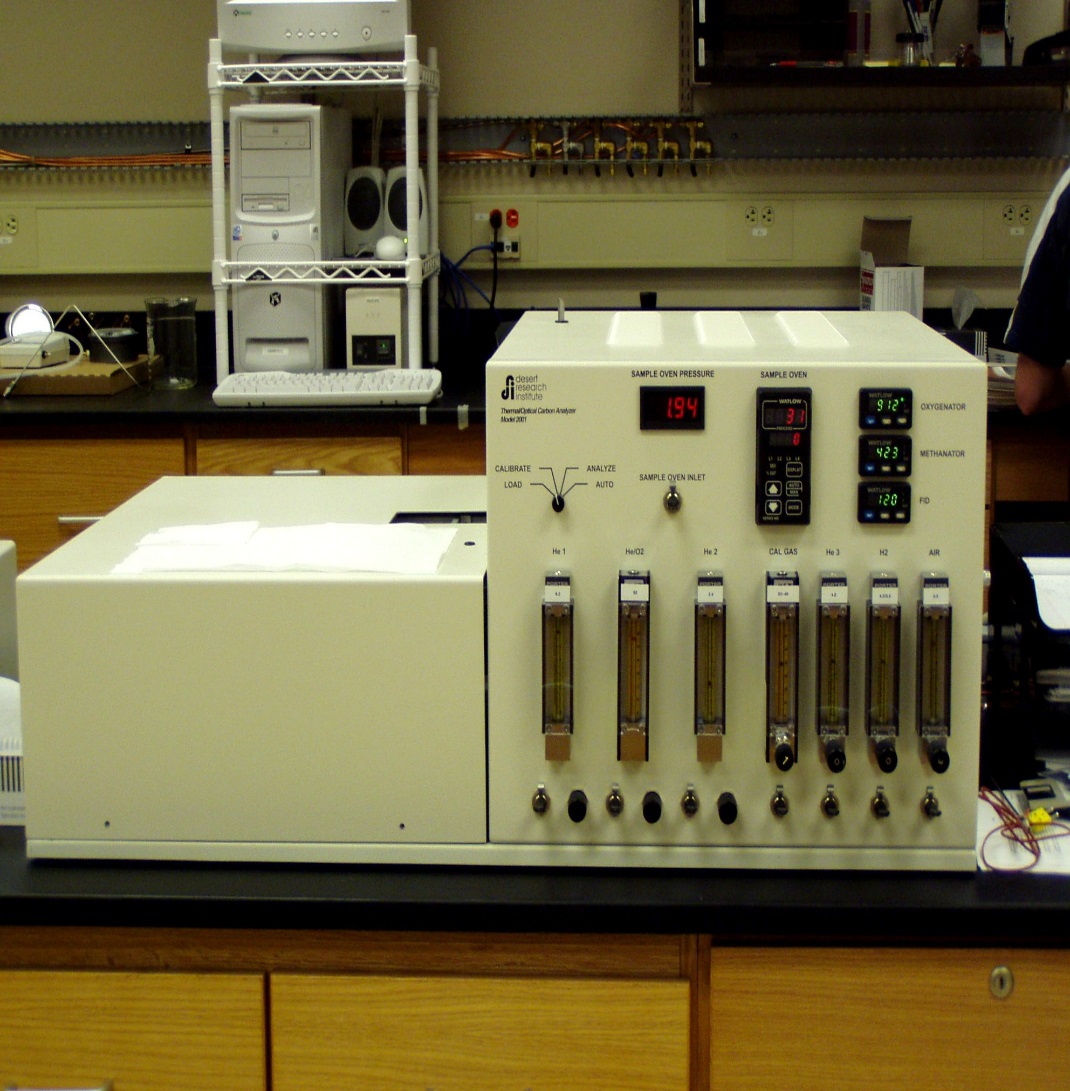
The operation of the DRI Model 2001 Thermal/Optical Carbon Analyzer is based on the preferential oxidation of organic and elemental carbon (OC and EC) compounds at different temperatures. Its function relies on the fact that organic compounds can be volatilized from the sample deposit in a non-oxidizing helium (He) atmosphere, while EC must be combusted with an oxidizer. The analyzer operates by: 1) liberating carbon compounds under different temperature and oxidation environments from a small sample punch taken from a quartz-fiber filter; 2) converting these compounds to carbon dioxide (CO2) by passing the volatilized compounds through an oxidizer (heated manganese dioxide, MnO2); 3) reducing CO2 to methane (CH4) by passing the flow through a methanator (hydrogen-enriched nickel catalyst); and 4) quantifying CH4 equivalents with a flame ionization detector (FID). Values routinely reported include total OC, total EC, total carbon (TC, sum of total OC and total EC), and pyrolyzed carbon, monitored by both reflectance (OPR) and transmittance (OPT). Depending on the thermal/optical protocol applied for quantification, thermally-derived subfractions of OC and EC, and of carbonate carbon, are reported.
Model: DRI 2001 Aerosol Filter Samples - Method IMPROVE_A Revision: 3 |
 |
|
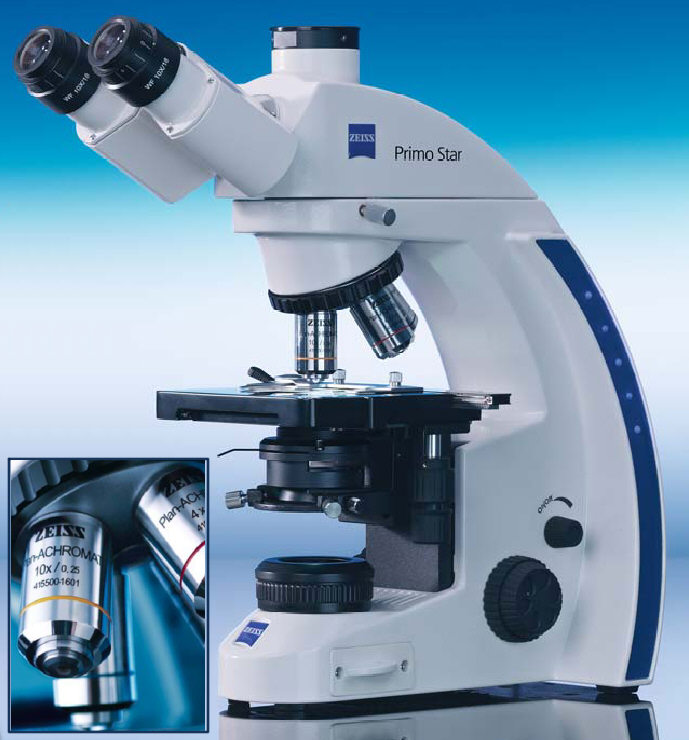
8. Carl-Zeiss Microscope
Carl-Zeiss microscopes used in applications of biology and medicine for the examination of blood, tissue etc., specimens, as well as for materials examinations. They may also be used as true reflected-light microscopes or, if equipped with a transmitted-light equipment, as combined reflected-light/transmitted-light microscopes. Typical applications of the Axio Imager microscopes include, for instance: Medical examinations in laboratories (research), clinics and medical practices. Science and research (colleges, universities) in the fields of medicine and biology. Industrial applications (pharmacology, food technology)
|
 |
|
9. Gas Chromatography
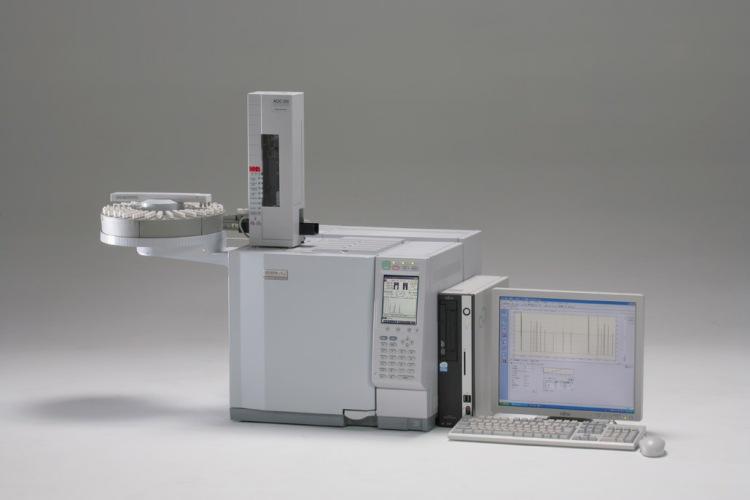
Gas Chromatography is an analytical instrument used in separating and analyzing compounds that can be vaporized without decomposition. The sample is transported through column by the flow of inert gaseous mobile phase such as helium, nitrogen, Argon & Zero air. Model: GC-2010, SHIMADZU Software: GC solution
|
 |
|
10. FACS
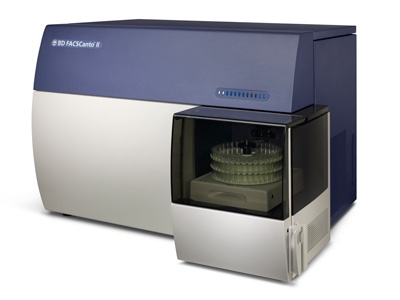
Flow cytometry is a laser-or- impedance based biophysical technology employed in cell counting, cell sorting and biomarker detection. The BD FACS verse flow cytometry system acquires and analyses particles or cells in a liquid suspension. Antibodies to specific cell proteins are labeled with a fluorescent dye and incubated with the cell suspension. The suspension flows through the cytometer and is interrogated by a laser which excites the fluorescent antibodies. The Fluoresence is captured and the resulting data is analyzed to reveal information about the cells. Make- BD FACS Verse, Software: BD FACSuite
|
 |